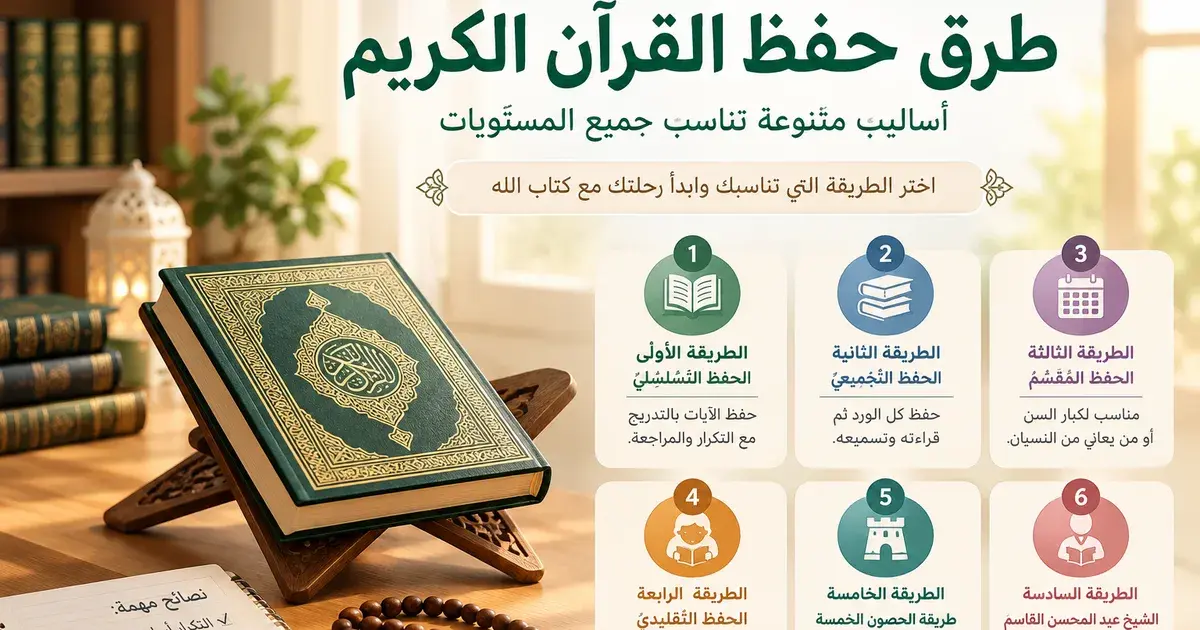
Quran memorization methods are many: choose the one that fits you
There are many different methods for memorizing the Quran (Hifz); choose the one that suits your level and circumstances, and there's no harm in combining two or more. What matters is memorizing the Quran thoroughly, not sticking to a particular method for its own sake.
1. Sequential memorization (Tasalsuli)
This is one of the best methods, because it links every verse to the next:
- Memorize the first verse by repeating it at least twenty times if you're not used to memorizing, then recite it several times until it's firmly set.
- Memorize the second verse the same way.
- Recite both verses together at least three times.
- Memorize the third verse, then recite all three verses together at least three times.
Continue this way until the end of your daily passage. Afterward, read the passage from the mushaf five times, recite it at least five times from memory, then read it during voluntary prayers and before sleeping. Beware of growing bored with repetition — it's essential for lasting memorization. Don't be fooled by fast memorization; repeat so you won't forget, not just to memorize.
2. Cumulative memorization (Tajmi3i)
- Memorize each verse on its own through repetition, without linking verses together.
- Read the whole passage several times from the mushaf after memorizing.
- Recite the passage several times until it's well mastered.
This method is weaker than the sequential one, because a verse can slip past unnoticed, especially in short verses like those in Surah Ash-Shu'ara. It suits fast memorizers who want to save time, but isn't recommended for someone starting to memorize for the first time.
3. Segmented memorization (Muqassam)
Suited to older people, or those who suffer from frequent forgetfulness:
- Select several verses close in meaning, and read a brief commentary (tafsir) on them.
- Repeat them at least twenty times with focus.
- Read them from the mushaf several times, then recite them until they're firmly set.
- The next day, review the previous memorization from the start of the surah before memorizing the new passage.
This method requires daily review from the start of the surah so the segments connect; for long surahs, review can be spread over several days, at no less than ten pages per day.
4. Traditional memorization (Taqlidi)
- Repeat the entire daily passage at least twenty times until the memorization is set.
- Read it from the mushaf five times, then recite it five times with intense focus so no verse slips by unnoticed.
This method suits young children capable of fast memorization, but requires strong concentration.
5. The Five Fortresses method (Hosoun al-Khamsa)
A comprehensive system built on five pillars:
First fortress: continuous reading and systematic listening (monthly preparation)
Read two Juz per day at most (no more than 40 minutes), with systematic listening to a full recitation at the rate of at least one Hizb per day.
Second fortress: preparation, the strongest pillar of all, made up of:
- Weekly preparation: reading each day of the current week the pages planned for the following week, listening to them once for correction, and reading a brief commentary on them.
- Nightly preparation: listening for 15 minutes, then reading from the mushaf for another 15 minutes the page to be memorized the next day.
- Immediate preparation: repeating the reading of the page for 15 minutes right before memorizing it, alternating between reading with and without the mushaf.
Third fortress: new memorization, at a rate of 15 minutes per page, with repetition and focus.
Fourth fortress: near review, reviewing daily the 20 pages adjacent to the newly memorized page, taking about 20 minutes.
Fifth fortress: far review, for the pages before those covered in near review, on a weekly basis: 40 pages per day during the first half of memorization, then 60 pages during the third quarter, then 80 pages during the final quarter.
6. Sheikh Abdul Muhsin Al-Qasim's method
Based on repeating each verse twenty times on its own, then linking it to the previous ones:
- The first verse, twenty times.
- The second verse, twenty times.
- The third verse, twenty times.
- The fourth verse, twenty times.
- All four verses together, twenty times, to link them.
- The fifth verse, twenty times.
- The sixth verse, twenty times.
- The seventh verse, twenty times.
- The eighth verse, twenty times.
- The fifth through eighth verses together, twenty times, to link them.
- The first through eighth verses together, twenty times, to master the whole page.
This method is applied to every page of the Quran, without memorizing more than one-eighth of a Juz per day, so the memorized text doesn't slip away through accumulation.
7. The "Memorize the Quran like Al-Fatiha" method
By Sheikh Durayd Ibrahim Al-Mawsili:
- Read the whole page 20 times, at a normal pace.
- Memorize the first line 10 times until mastered.
- Memorize the second line 10 times.
- Review both lines together 10 times.
- Repeat this process for each line until the end of the page, then review the whole page from memory 10 times.
- The next day, memorize the new page the same way, then review the old page with the new one from memory 10 times, and recite both to a study companion.
- As pages accumulate, gradually review memorized Juz: after completing one Juz, review it daily after the new memorization; after four Juz, review three Juz per day on rotation.
- Those who have completed memorizing the entire Quran are advised to review five Juz daily, or at least three when busy.
8. The Five T's method
By Dr. Yahya Al-Ghawthani, made up of five steps:
- Preparation: setting your intention, performing ablution, and sitting in a quiet place such as a mosque.
- Warm-up: reading a few pages from any part of the Quran aloud, with good voice, for about 10 minutes.
- Focus: opening the mushaf to the verses to be memorized, staring at them intensely, then reciting the first verse aloud with correct, properly applied Tajweed.
- Repetition: repeating the verse three times or more, then closing your eyes and recalling it from memory, repeating that too, reading it once more from the mushaf, and finally reciting it purely from memory.
- Linking: connecting each verse to the next by reading the end of the first verse straight into the following one without pausing, repeating at least five times.
9. The verse-and-page linking method
Similar to the sequential method, with an addition: reading the first word or two of the next verse together with the current one to link them, and memorizing the first verse of the following page before finishing the current page, to link the pages together.
10. The facilitated memorization method (Hifz Al-Muyassar)
It consists of three steps:
First: before memorizing
Reading the passage once slowly, then the thematic links, word meanings, reflection points, and the verbal and semantic links within the passage.
Second: memorizing
- Memorize the first verse by repeating it aloud at least twenty times with intense focus.
- Close the mushaf and recite it from memory five times.
- Do the same with the second verse.
- Recite both verses together from memory five times.
- Do the same with the third verse, then recite all three together five times, and so on until the end of the passage, then link the passages together, then link the page with what came before.
Third: review
Continuous review of the near and far past, gradually increased until reaching three Juz reviewed daily after the new memorization.
11. Combining methods: Sequential + Five Fortresses + Facilitated memorization
Several methods can be combined. A practical example: memorizing one passage per day (half a page), for 6 passages a week (3 pages), leaving Friday free of new memorization and review. At this pace, the entire Quran can be memorized in about 4 years, across three phases:
Phase one: preparation
- A daily Quran reading portion: at least one Juz (about 20 minutes).
- Weekly preparation: reading the upcoming quarter once a day throughout the week.
- Nightly preparation: listening 3 times before sleep to tomorrow's passage in the voice of a well-known reciter, then reading it from the mushaf 5 times.
- Listening to a simplified explanation of the passage or reading a brief commentary on it.
Phase two: memorizing
Reading the links, meanings, and reflection points, then memorizing the verses one after another by repeating the first verse twenty times, reciting it from memory five times, then progressively linking the verses as in the facilitated method.
Phase three: review
- Near past: daily review of the five pages (gradually increased to 20) preceding the new passage.
- Far past: reviewing 10 pages daily of the rest of what's been memorized until it's all covered, then starting over from the beginning, gradually increasing.
Which method is best?
The answer differs from person to person — these are means, not ends in themselves. Choose the method that fits your nature and circumstances, and there's no harm in combining two or more. What matters is memorizing the Quran thoroughly, and staying consistent even if slowly.
How the Noor Phonetic Quran app supports you
Whichever method you choose, the Noor Phonetic Quran app gives you the tools to apply it easily: verse-by-verse audio repetition, daily tracking of your passage and review, a memorization plan with customizable goals, and a structured review mode that distinguishes near past from far past. This lets you focus on memorizing itself, without the extra effort of organizing your schedule.